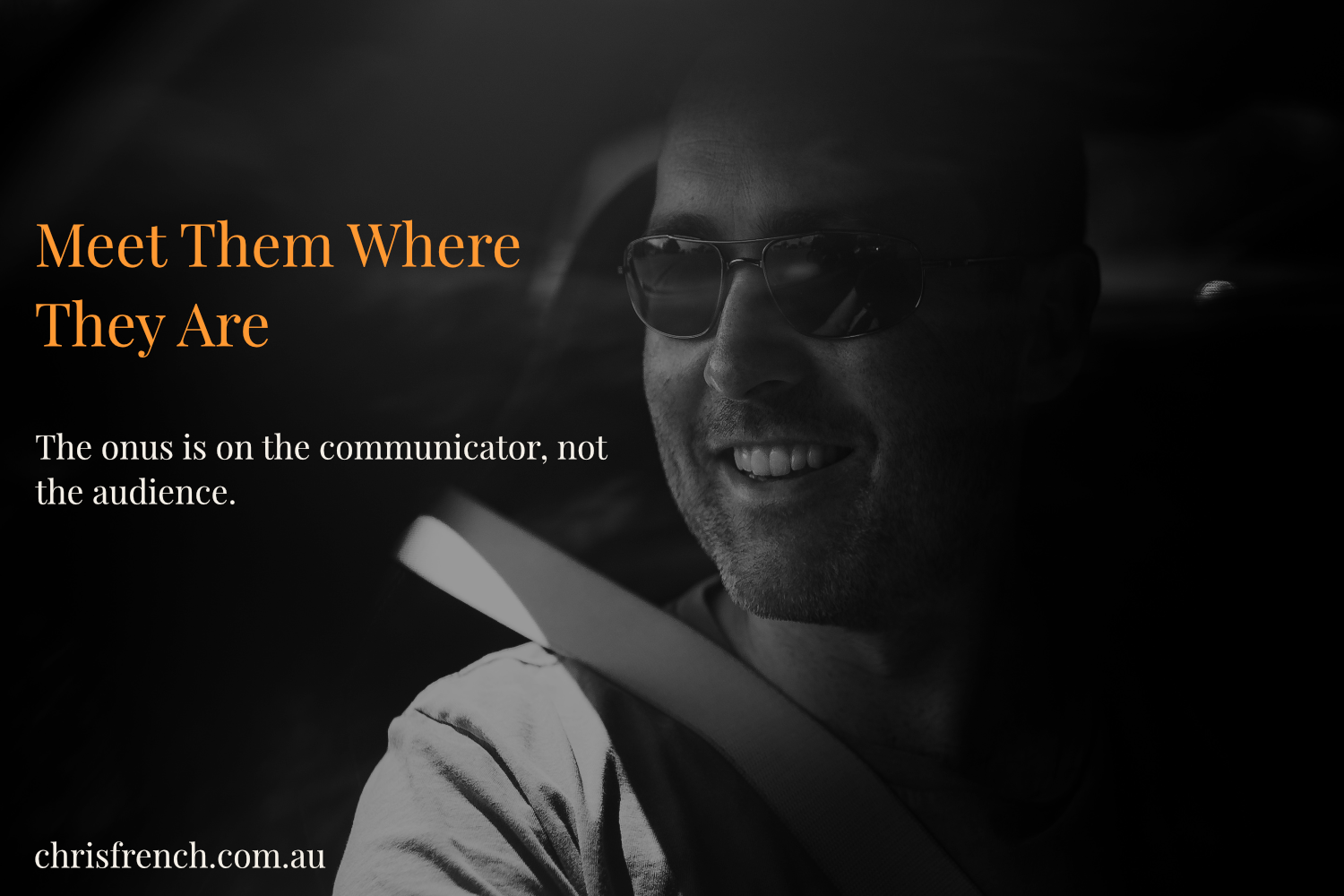
Meet Them Where They Are
On storytelling, communication, and the quiet discipline of being received
I heard a piece of advice this week that's been ringing in my head ever since.
It was about storytelling. The advice was simple: know who you're telling your story to. Don't make it about you. Don't tell your story. Tell them a story that's relevant to them.
It sounds obvious. It isn't. Because the default, for almost everyone, in almost every medium, is to start from the inside out. We tell the story we want to tell, in the words that feel natural to us, from the vantage point that's most comfortable. And then we wonder why it doesn't land.
I've been turning this over because it connects to something bigger I've been thinking about for a while now. Something that runs through every part of my life. The writing, the VFX work, the way I try to parent, the way I try to show up for the people I love.
The onus is on the communicator.
Not the audience. Not the listener. Not the reader. The person doing the communicating.
The Default We Don't See
There's a quiet arrogance baked into how most of us communicate. We say a thing, in our words, in our framing, with our reference points, and then we get frustrated when the other person doesn't get it. Doesn't change. Doesn't move. Doesn't receive it the way we intended.
But here's the thing: people aren't standing where you're standing. They never are. They have their own history, their own pressures, their own language, their own internal weather. They are not a blank receiver waiting to be filled with your perfectly-formed thought. They are a person, mid-life, mid-thought, mid-something-you-don't-know-about.
If you want to be received, you have to translate. You have to do the work of finding the words they can hear. The metaphor they can hold. The rhythm they can follow.
This is not dumbing down. This is not flattery. This is craft.
It's the same thing a good novelist does when they pick the right opening sentence for the right reader. It's the same thing a good director does when they choose where to put the camera. It's the same thing a good friend does when they sit beside someone in pain and choose, carefully, what not to say.
What This Looks Like in Fiction
I've been writing a middle-grade fantasy novel about a nine-year-old boy named Ethan whose world has fallen apart. His mum has remarried. His stepfamily is unbearable. The kids at school have turned on him. And then a Minotaur kidnaps his only friend in a thunderstorm, and he dives through a glowing portal in his bedroom to save him.
If I were writing that story for me, I'd write it dense. I'd lean into the symbolism. I'd let the prose breathe in slow, layered paragraphs. I'd probably overcook the metaphor about fear.
But I'm not writing it for me. I'm writing it for nine-year-olds, and for the parents who'll read it beside them. So the chapters are short. The action moves. The fear is real but the language is clean. Ethan's inner journey, the part of the book I actually care about most, the part about confronting the darkness inside before it eats you, has to be carried by what happens, not by what's explained.
Because if I write the version that satisfies me, no nine-year-old finishes it. And then the story I cared about telling never reaches the person it was meant for.
The story doesn't change. The delivery changes. The translation is the work.
What This Looks Like in Friendship
Same principle, different room.
When I want to spend time with a friend I haven't seen in a while, the old version of me would send a text: Hey, want to grab a coffee? And then I'd be quietly disappointed when they said they were too busy.
But people are busy. That's not a moral failing. That's life. They have kids, they have deadlines, they have the slow-grinding work of holding their own world together.
So the question isn't will you come to me? The question is where are you already?
I know you walk every morning. Can I walk with you? I know you bake on Sundays. Can I come bake? I know you're slammed this month. Can I drop off dinner Tuesday?
That's meeting people where they are. It's not asking them to add you to their life. It's offering to join the life they're already living.
It costs almost nothing. And it almost always works.
What This Looks Like at Work
In VFX, I've spent years building pipelines and leading teams across films like Sonic the Hedgehog 3, The Creator, and Alien: Earth. And I'll tell you the single biggest failure mode I see in technical leadership. It's not bad code. It's not bad planning. It's communicators who refuse to translate.
A supervisor who explains a problem in the language of the supervisor, to an artist who needed it in the language of the artist. A producer who delivers a deadline like a deadline, to a creative team that needed it as a context. A director who gives a note in director-shorthand, to a department that needed it as a brief.
And every time the message doesn't land, the same thing happens: the communicator gets frustrated, the receiver feels stupid or unseen, the work suffers, and trust erodes.
The fix is almost always the same. Slow down. Find out where the other person is standing. Speak from there.
It is not the receiver's job to climb up to where you're standing. It is your job to come down and meet them.
The Mindfulness Underneath
This is where it all loops back for me, to the work I've been quietly building on the mindfulness and leadership side of my life.
Because being able to do this, to genuinely meet someone where they are, requires something most communication advice glosses right over.
It requires you to be regulated enough to notice the other person at all.
If you are anxious about whether your point is landing, you cannot read the room. If you are attached to being right, you cannot hear what's being said back. If you are performing your story instead of telling it, you cannot adjust to your audience.
You have to be settled inside yourself first. You have to drop the fear that the message has to land in this particular way, in this particular moment, or you will be diminished by it. Once that fear is gone, or quieter, at least, you can finally see the person in front of you. And once you can see them, you can speak to them.
This is the part of leadership nobody puts on the org chart. The internal work that makes the external work possible. The reason "invest in people" isn't a slogan. It's a methodology. You can only invest in someone you can actually see. And you can only see them once you've stopped staring at your own reflection in the conversation.
The One Thing
If I had to compress all of this into one line, it would be this:
The story is not what you said. The story is what they heard.
Whether you're writing a novel, leading a team, repairing a friendship, or trying to be a better parent, the bar is not whether you communicated. The bar is whether you were received.
And being received is a craft. It takes humility, attention, and a willingness to do the translation work that no one will ever thank you for.
But when you do it, something shifts. The walls come down. The other person leans in. The story you've been trying to tell for years finally lands, because for the first time you actually told it in their language.
That's the whole game.
That's why I write.
3 Things You Can Do Today
Small enough to do this week. Powerful enough to change how you communicate forever.
1. In your next real conversation, ask one extra question before you reply
Before you respond, ask one question that helps you locate where the other person actually is. "What's going on for you with this?" or "What does this look like from your side?" You're not solving yet. You're locating. Most of us skip this step entirely and pay for it later.
2. Rewrite one message you've already sent
Pull up your last text, email, or Slack message that didn't land the way you hoped. Don't send anything. Just rewrite it in the language the other person would have actually heard. Notice what you had to change. That gap is the translation work, and you can feel it in your hands once you've done it once.
3. Reach out to one person by joining their life, not adding to it.
Pick a friend you've drifted from. Don't invite them to something new. Instead, find out what they're already doing this week and offer to be there for some of it. Walk with them. Cook with them. Sit on their porch. Watch what happens when you remove the cost of saying yes.
Stories are my life. Let me tell you one, in a way you can hear it.